Aerostatic bearings
Clean compressed air is fed through orifices, grooves, slots, porous media, or compensating restrictors. Load support exists before the axis moves.
Air bearings · gas bearings · precision motion
Aerostatic and aerodynamic bearings remove rolling-element contact for metrology, semiconductor, optical, spindle, and ultra-precision motion.
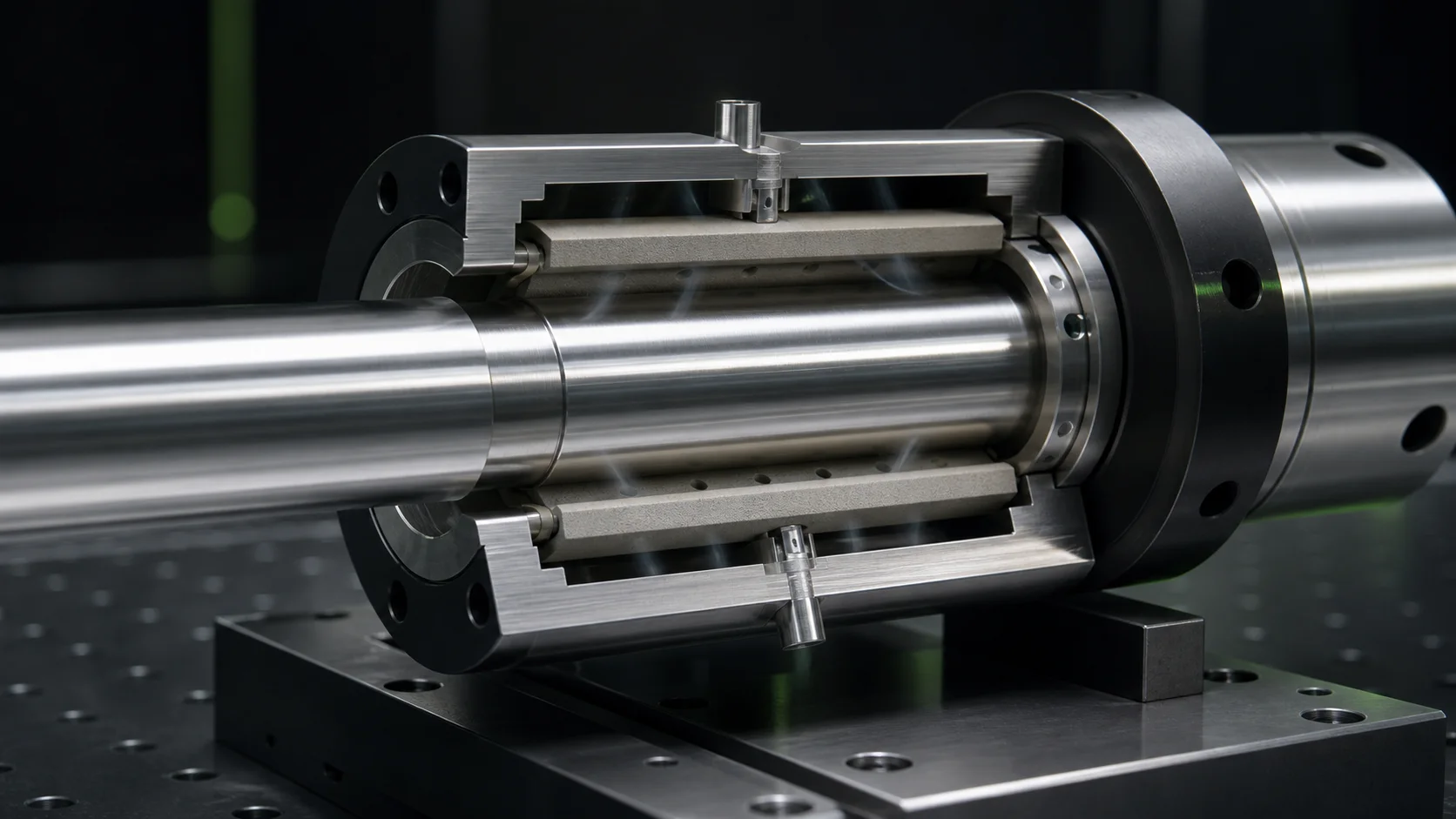
Because there is no rolling-element recirculation or lubricant film contamination, air bearings can deliver smooth motion and exceptional repeatability. The trade is system sensitivity: a small particle, geometric error, pressure change, or crash event can consume a large share of the operating clearance.
Clean compressed air is fed through orifices, grooves, slots, porous media, or compensating restrictors. Load support exists before the axis moves.
Relative surface motion generates gas-film pressure. Foil bearings and self-acting gas journal bearings need sufficient speed before full lift develops.
Flat pads or guideways support translation with very low friction and no rolling-element pitch error. Straightness depends on the reference surfaces.
Journal, thrust, and conical air films support high-speed or ultra-precise rotation for metrology, machining, scanning, and optical systems.
| Architecture | Behavior | Design focus |
|---|---|---|
| Discrete orifice | Air enters through individual calibrated holes or inserts. | Orifice balance, groove geometry, pressure distribution, clogging. |
| Porous media | Flow is distributed through a permeable bearing face. | Permeability uniformity, filtration, surface preparation, crash resistance. |
| Slot or groove fed | Machined restrictions spread supply around the load area. | Manufacturing accuracy, flow stability, pneumatic hammer avoidance. |
| Vacuum preloaded | Opposing pressure and vacuum create bidirectional stiffness on one-sided stages. | Supply balance, flatness, vacuum capacity, contamination control. |
| Opposed pads | Air films on both sides constrain motion and establish preload. | Gap setting, structural loop, thermal stability, assembly alignment. |
Debris ingestion, wet or oily air, blocked restrictions, insufficient supply, geometric error, thermal bow, pneumatic instability, overloading, impact, and uncontrolled touchdown can damage an air-bearing system. Cleanroom compatibility does not remove the need for air preparation and material review.
Reference-quality motion without recirculating-element error or stick-slip.
Clean motion, tight error budgets, scanning, and controlled thermal behavior.
Low disturbance forces, smooth velocity, and angular repeatability.
High-speed rotation with low synchronous error and no lubricant contamination.
Low friction, predictable stiffness, and reduced hysteresis in sensitive measurements.
Quiet, clean, repeatable positioning where contamination control matters.
It supports a moving surface on a very thin pressurized gas film. Aerostatic bearings use an external air supply; aerodynamic bearings generate pressure through relative motion and geometry.
They eliminate sliding and rolling contact during normal operation, but gas shear, pressure flow, seals, cables, and auxiliary systems still create force and energy loss.
Most aerostatic systems need clean, dry, regulated air. Filtration, dew point, oil carryover, pressure stability, and flow capacity should be specified with the bearing supplier.
They can carry substantial loads when area, pressure, preload, structure, and restrictor design are appropriate. Load capacity alone does not establish stiffness, accuracy, or crash margin.