Hydrodynamic bearings
Journal motion drags lubricant into a converging clearance and builds a pressure wedge. Full-film separation develops after sufficient speed, viscosity, and geometry align.
Liquid bearings · fluid-film bearings
Hydrodynamic, hydrostatic, water-lubricated, and process-fluid bearings replace point contact with a pressure field distributed across a film.
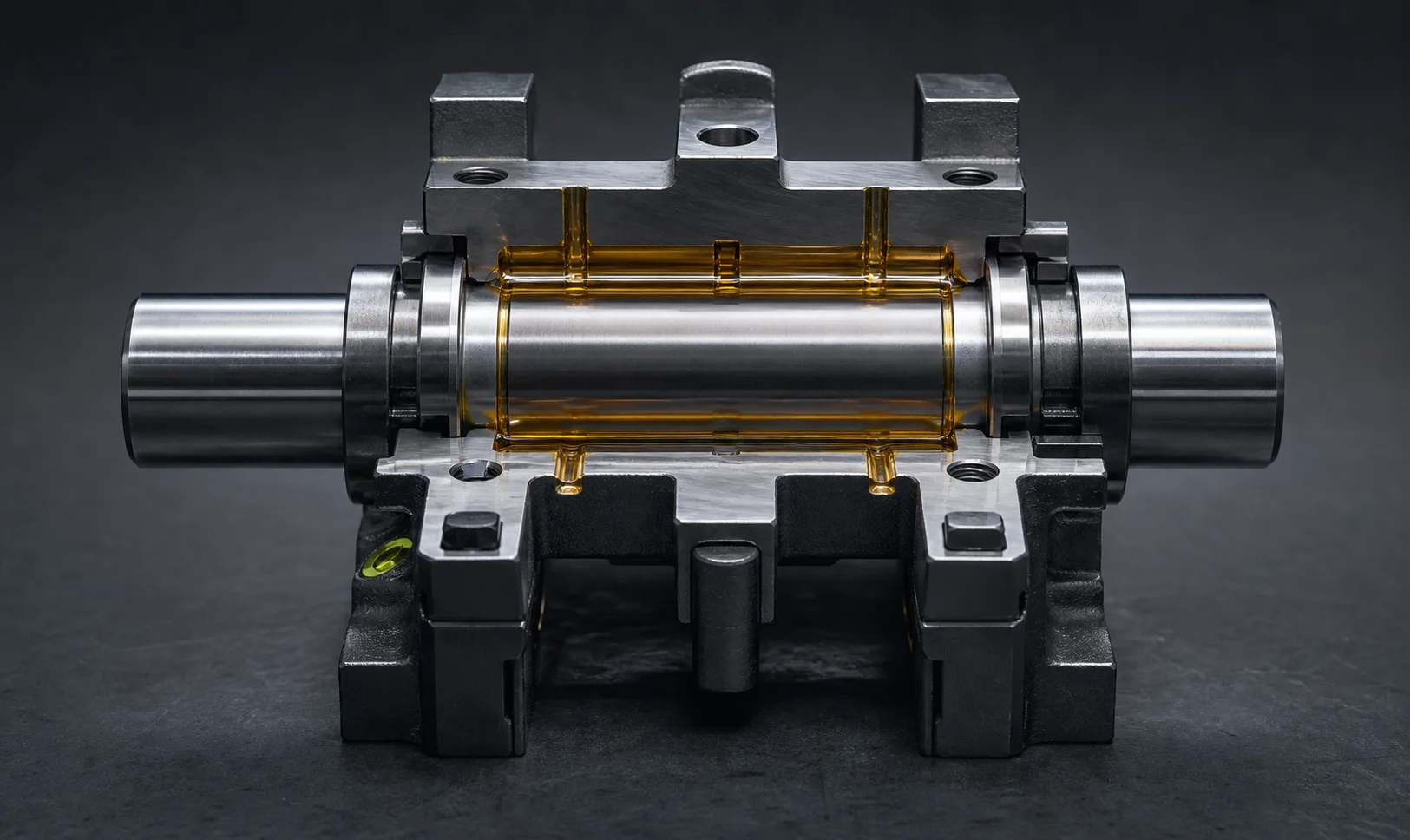
The design problem is larger than choosing a bushing material. Geometry, clearance, viscosity, speed, load, temperature, pressure, supply grooves, restrictors, filtration, surface finish, alignment, cooling, startup, shutdown, and transient events determine whether a stable film forms.
Journal motion drags lubricant into a converging clearance and builds a pressure wedge. Full-film separation develops after sufficient speed, viscosity, and geometry align.
An external pump sends pressurized liquid through restrictors into bearing pockets. Load capacity and stiffness exist before the surface begins moving.
Engineered polymers, composites, ceramics, and metals operate with water as lubricant and coolant in marine, pump, turbine, and hygienic equipment.
The pumped or compressed fluid itself can lubricate the bearing, reducing contamination interfaces while making chemistry and upset conditions central design inputs.
| Design question | Hydrodynamic | Hydrostatic |
|---|---|---|
| Pressure generation | Relative motion creates the fluid wedge. | External pump and restrictor system create pressure. |
| Load at zero speed | Little or no full-film support before lift-off. | Designed to support load before motion begins. |
| System infrastructure | Reservoir, delivery, cooling, filtration as required. | Pump, filters, pressure regulation, restrictors, plumbing, monitoring. |
| Typical advantages | High load, damping, quiet service, mature architecture. | Low starting friction, controlled stiffness, precision at slow speed. |
| Common concerns | Startup wear, minimum speed, thermal stability, oil whirl or whip. | Pressure loss, restrictor balance, leakage, pump heat, fail-safe behavior. |
Oil starvation, cavitation, aeration, contamination, mixed-film wear, wipe, corrosion, edge loading, overheating, unstable whirl, blocked restrictors, pressure loss, and improper startup can defeat a theoretically adequate bearing. Instrumentation for temperature, pressure, flow, vibration, and displacement can be part of the bearing system.
High load, damping, rotor stability, and long continuous operating intervals.
Process-fluid lubrication, contamination control, pressure, and upset handling.
Hydrostatic stiffness, low-speed accuracy, damping, and thermal management.
Water-lubricated stern tubes, pumps, corrosion, debris, and dry-running transitions.
Compact hydrodynamic journals, high temperature, speed, and transient lubrication.
Load capacity, shock, contamination, maintainability, and condition monitoring.
A liquid bearing supports a shaft or moving surface on a pressurized film of oil, water, or another liquid. Pressure may be generated by motion or supplied by an external system.
Hydrodynamic bearings build pressure from relative motion. Hydrostatic bearings use an external pump, allowing load support before motion and at very low speed.
Yes, in systems designed for water's lower viscosity, corrosion behavior, chemistry, cooling, contamination, and material compatibility. It is not a drop-in substitution.
Not universally. Full-film operation can eliminate steady-state surface contact, but startup, shutdown, overload, contamination, starvation, or instability can create mixed-film or boundary contact.