Hybrid silicon-nitride bearings
Silicon-nitride balls run on hardened steel or stainless races. This is the common advanced option for high-speed spindles, motors, and electrically sensitive systems.
Ceramic bearings · hybrid ceramic · silicon nitride
Hybrid ceramic bearings use advanced rolling elements to change speed capability, electrical conduction, centrifugal loading, stiffness, heat, and failure behavior.
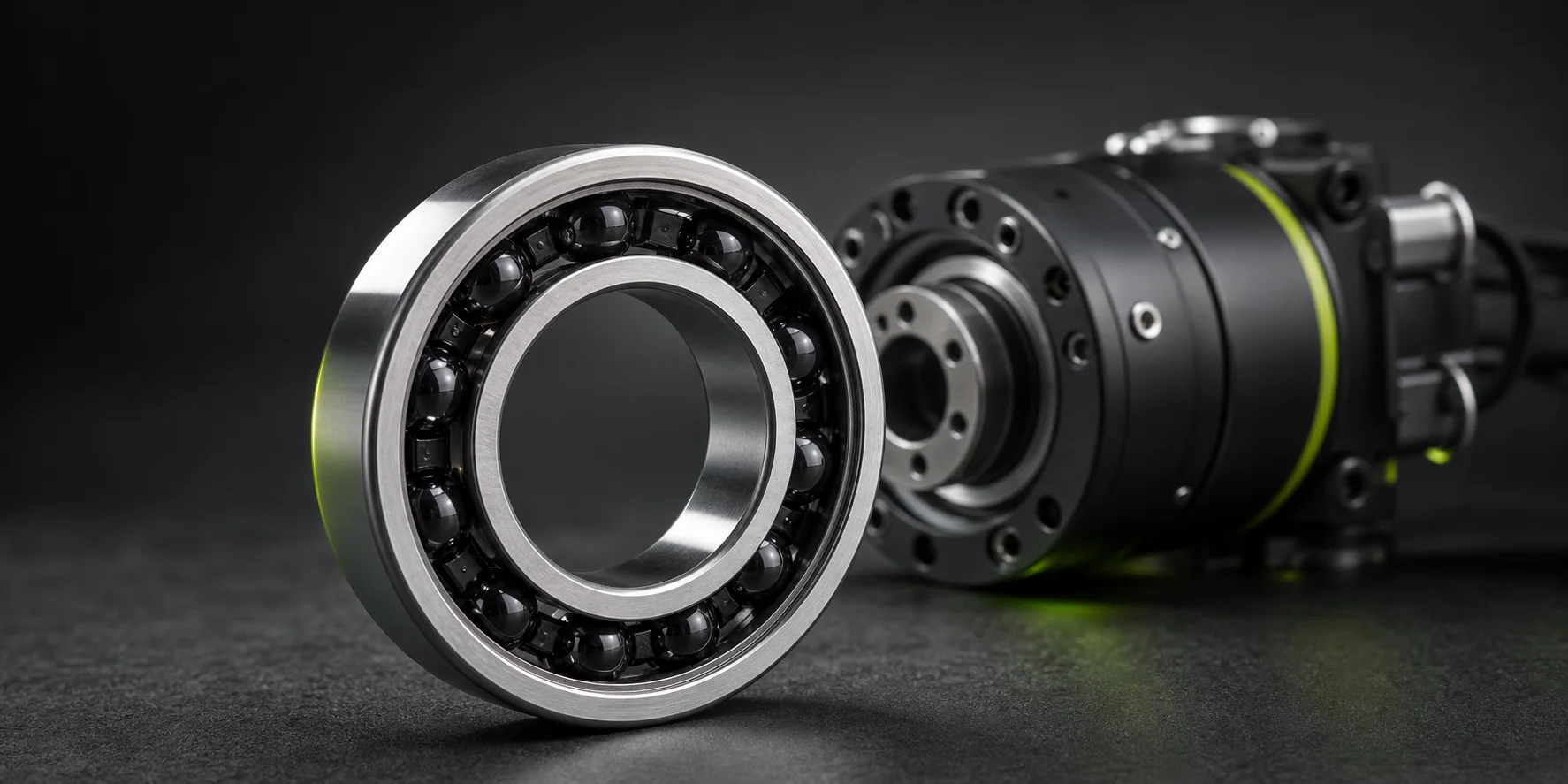
Silicon-nitride balls run on hardened steel or stainless races. This is the common advanced option for high-speed spindles, motors, and electrically sensitive systems.
Ceramic rings and balls can address temperature, corrosion, electrical, or vacuum constraints, but ring brittleness and mounting need deliberate engineering.
Zirconia offers corrosion resistance and toughness relative to some ceramics, with greater density and different temperature and electrical behavior than silicon nitride.
An insulating coating on a steel ring is another architecture for motor-current mitigation. It should not be confused with ceramic rolling elements.
Material names are not enough. Ball grade, density, elastic modulus, thermal expansion, conductivity, surface finish, defect control, raceway quality, cage, lubricant, preload, and mounting define the working bearing.
| Property | Potential benefit | Design caution |
|---|---|---|
| Lower rolling-element density | Lower centrifugal force and gyroscopic load at high speed. | Raceway stress, cage behavior, lubricant, and preload remain limiting. |
| Higher elastic modulus | Smaller contact ellipse and potentially greater local stiffness. | Contact stress and sensitivity to raceway defects may increase. |
| Electrical resistance | Can interrupt current flow through the rolling contact. | Capacitive discharge, contamination, frequency, and alternate paths still need analysis. |
| Hardness + surface behavior | Resistance to adhesive wear and some contamination damage. | Hard particles can indent or damage steel raceways; filtration still matters. |
| Thermal expansion difference | Can support certain high-temperature or precision strategies. | Internal clearance and preload shift with temperatures across the assembly. |
A hybrid bearing is not automatically longer-lived, faster, quieter, or more efficient. It can solve specific centrifugal, electrical, tribological, or environmental problems when the races, cage, lubricant, preload, fits, and machine structure are designed around it.
Rolling-element mass, preload, heat, lubricant, runout, and spindle dynamics.
Bearing-current mitigation, electrical isolation, speed, grease life, and grounding strategy.
Low rolling-element mass, acceleration, stiffness, electrical path, and clean motion.
Material outgassing, lubricant selection, electrical isolation, temperature, and cage behavior.
Shaft current, rotor speed, thermal management, shock, and production validation.
Full-ceramic or hybrid construction evaluated against chemistry, shock, fit, and cost.
It combines steel or stainless races with ceramic rolling elements, commonly silicon-nitride balls. The construction keeps metal-ring toughness while changing rolling-element mass, stiffness, conductivity, and tribology.
Ceramic rolling elements can interrupt the conductive path through the bearing, but total system insulation depends on voltage, frequency, contamination, geometry, and alternate paths.
Not in every sense. Ceramics can offer hardness, corrosion, temperature, or electrical advantages, but brittleness makes shock, mounting, ring support, and defect control especially important.
Many do. Ceramic material changes contact behavior but does not automatically eliminate friction, heat, cage interaction, raceway wear, or contamination. Lubrication must match the complete bearing and duty.